What is an EICR and how often do you need one?
An EICR (Electrical Installation Condition Report) is a written report on the condition of the fixed electrics in a building: the wiring, the fuse board, sockets, switches and light fittings. In England, private landlords must have one done at least every five years and give their tenants a copy. For a home you own, the usual advice is every ten years, and for shops, offices, cafes and restaurants it is every five years.
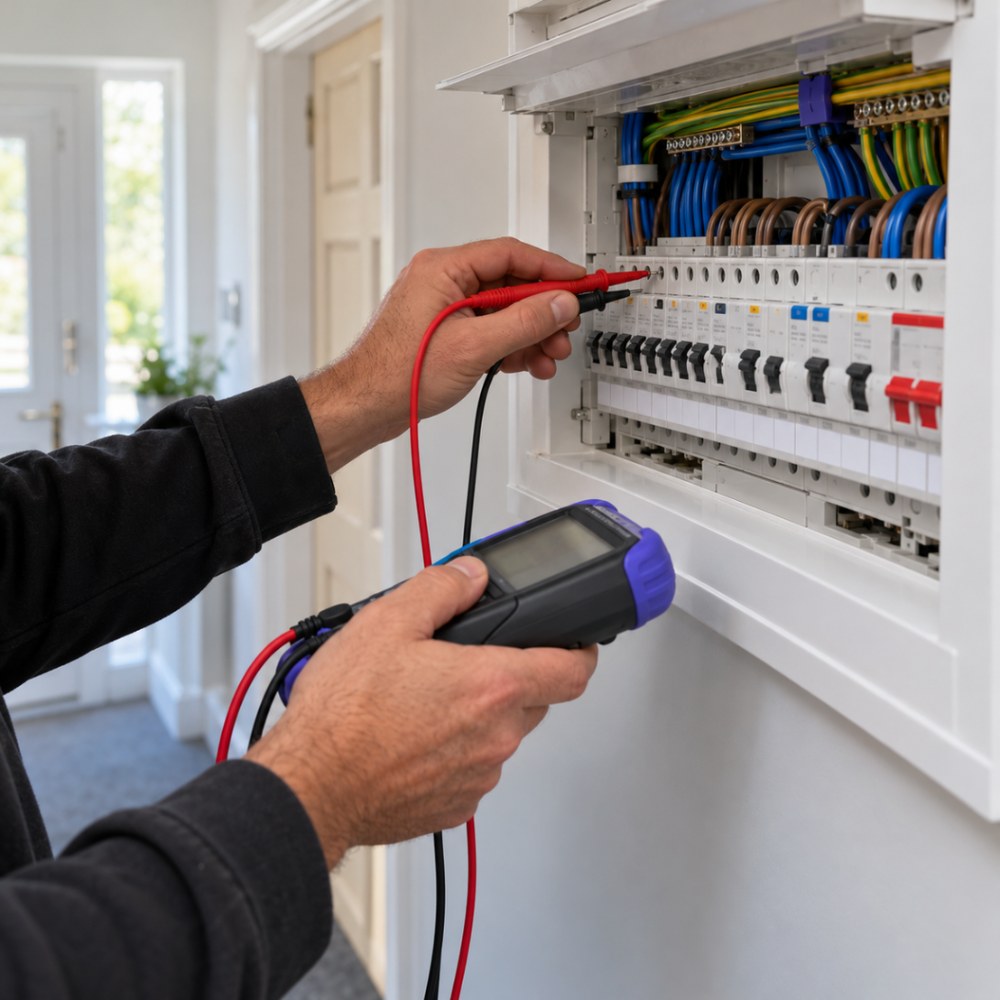
What an EICR checks
An EICR looks at electrics that are already in place. A qualified electrician inspects them by eye, tests them circuit by circuit and writes up what they find. Electrical Safety First says the inspection will:
- Show whether any circuits or equipment are overloaded
- Find anything that could cause an electric shock or a fire
- Pick up faulty electrical work
- Show where earthing or bonding is missing
Earthing and bonding are the connections that give a fault a safe path, so that metal parts you might touch do not become live. NICEIC adds that the inspector looks for DIY alterations that may not meet the regulations, and checks that if a fault happens the power cuts off quickly.
What the result codes mean
Anything that needs attention gets a code. GOV.UK explains them:
Danger present
There is a risk of injury now. The electrician may make it safe before they leave.
Potentially dangerous
Repair work is needed.
Improvement recommended
Not dangerous, and no repair is needed for the report to pass. Doing it would make things safer.
Further investigation
Something needs looking into without delay.
Satisfactory or unsatisfactory
The report ends with an overall verdict.
Unsatisfactory
- There are any C1 or C2 codes
- It is not safe to keep using as it is
Satisfactory
- No codes, or only C3s
- NICEIC says C3 and FI codes on their own do not make it unsatisfactory, although a landlord must still get any FI looked into
How often do you need one?
The report gives the date of the next inspection, which can be sooner if the wiring is old or worked hard. As a guide:
- Privately rented homes in England
- At least every five years, by law, or sooner if the report says so
- Social rented homes in England
- The same five year rule now applies, after the regulations were extended in 2025
- Homes you own and live in
- Every ten years is recommended by Electrical Safety First and NICEIC. It is not a legal requirement
- Buying or selling
- Electrical Safety First recommends an inspection before you sell, or before you buy a home someone has lived in
- Shops, offices, restaurants, cafes and hotels
- Every five years, the interval IET guidance gives for commercial premises
- Factories, workshops and warehouses
- Every three years under the same guidance
- Dentists, vets, clinics and other workplaces
- No fixed date in law. The electrician sets the next one from the condition and age of the installation, and your insurer may set its own
What happens on the day
- Clear access to the fuse board, sockets and switches, so move anything in the way.
- The power goes off for part of the visit while circuits are tested. Plan around freezers, computers, tills and anything else that needs to stay on.
- NICEIC says a small home can take a few hours, and larger premises a full day or several days.
- You get the written report afterwards.
If faults are found
- C1
Straight away
May be made safe there and then.
- C2
Put right
C2 items need repairing.
- FI
Investigate
FI items need investigating.
- C3
When it suits you
C3 items can be planned in.
- After
In writing
Once repairs are done you should get written confirmation that the work has been completed.
For landlords
The Electrical Safety Standards in the Private Rented Sector (England) Regulations 2020 applied to new tenancies from 1 June 2020 and to existing tenancies from 1 April 2021. GOV.UK says you must:
- Give existing tenants a copy of the report within 28 days of the inspection.
- Give new tenants a copy before they move in, and anyone thinking of renting a copy within 28 days of asking.
- Give the council a copy within 7 days if it asks, and keep a copy to hand to the next inspector.
- Get repair work or further investigation done within 28 days, or sooner if the report says so.
- Send the tenant and the council written confirmation within 28 days of that work being finished.
Do you need a new report between tenants?
Not necessarily.
GOV.UK says that if the last inspection was under five years ago and no further work was needed, you do not need a new one. You must give the new tenant the latest report, and a visual check before re-letting is recommended. Councils can fine landlords who break the rules up to £40,000.
For businesses
If you run a shop, cafe, office, surgery or practice, the Electricity at Work Regulations 1989 say that all systems must be maintained to prevent danger, so far as is reasonably practicable. The law gives no date. The Health and Safety Executive says to test often enough that there is little chance of danger building up in between. An EICR on the schedule your electrician sets is the usual way to show you have done that.
Check your insurance
Some insurers make fixed wire testing (the trade name for an EICR on business premises) a condition of cover, so check your policy.
If you cannot close, ask for the testing to be done out of hours or one area at a time.
How PulseNord does it
PulseNord is the electrical contractor in Nord Group, based in Bilsthorpe and working across Nottinghamshire, Derbyshire, Lincolnshire, Leicestershire, and South and West Yorkshire. We do EICRs and landlord certificates for homes, and fixed wire testing for businesses.
We test what is actually there and tell you plainly which parts are fine. Each code is explained in plain words and put in order of priority, so you can deal with the important ones first. Nothing gets condemned to sell you a job.
Need an EICR for a rental, a sale or your premises? Request a quote from PulseNord and you will get the price in writing before anything is booked.
Get a QuoteQuestions people ask
Is an EICR a legal requirement if I own my home?
No. The legal duty in England applies to landlords. For a home you own and live in, Electrical Safety First and NICEIC recommend an inspection at least every ten years, and before you sell or buy.
Do I need a new EICR every time a tenant moves out?
Not if the last report is under five years old and no further work was needed. You must give the new tenant a copy of the latest report before they move in, and GOV.UK recommends a visual check before re-letting.
Does a C3 code mean my EICR has failed?
No. A C3 means an improvement is recommended, not that anything is dangerous. Only C1 or C2 codes make a report unsatisfactory.
Will the power be off during an EICR?
Yes, for part of the visit, while circuits are tested. A small home usually takes a few hours. Businesses can ask for the testing to be done out of hours or one area at a time.
Where these facts come from
- Landlord duties: 5 year interval, copies to tenants (28 days), new and prospective tenants, council (7 days), record keeping, 28 day remedia…checked 2026-10-22
- Regulations updated in 2025 to include social rented sector; 5 year check by a properly qualified personchecked 2026-10-22
- Regulations applied to new tenancies from 1 June 2020 and existing tenancies from 1 April 2021checked 2026-10-22
- What a periodic inspection checks (overloading, shock and fire risks, defective work, earthing and bonding); 10 years owner-occupied, 5 year…checked 2026-10-22
- Unsatisfactory verdict when dangerous or potentially dangerous conditions found; remedial action without delaychecked 2026-10-22
- EICR definition, DIY alterations, insulation and earth fault loop tests, homeowners at least every 10 years, codes, C3 and FI do not make re…checked 2026-10-22
- Power turned off for part of the visit; clear access to fuse box and electrical points; around three hours (social landlord example)checked 2026-10-22
- IEE/IET Guidance Note 3 maximum intervals as reproduced by RSA: domestic 10 years, commercial 5 years, industrial 3 yearschecked 2026-10-22
- Commercial premises generally inspected at five yearly intervals; domestic every ten years (Ecclesiastical Insurance guidance PD5151 06/24)checked 2026-10-22
- IET Guidance Note 3 Table 3.2 as summarised: commercial (offices, shops, restaurants, hotels) 5 years, industrial 3 yearschecked 2026-10-22
- Electricity at Work Regulations 1989, regulation 4(2): systems maintained to prevent danger so far as reasonably practicablechecked 2026-10-22
- HSE: installations tested often enough that there is little chance of deterioration leading to danger; no fixed legal intervalchecked 2026-10-22
- Dental practices: contractor advises retest interval; some insurers make fixed wire testing a condition of coverchecked 2026-10-22
- PulseNord services (EICRs and landlord certificates, fixed wire testing and periodic inspection), coverage, codes explained in plain words, …checked 2026-10-22
- PulseNord terms: 25% deposit on accepting the quotation, balance on completion once certificate issued, workmanship guaranteed for twelve mo…checked 2026-10-22