Signs your fuse board needs replacing
Your fuse board, also called a consumer unit or fuse box, is where your home's electricity is split into circuits and protected. It is time to replace it if it still has old fuses that are rewired or replaced by hand, if it has no RCDs (the switches that cut the power in a split second when electricity goes where it should not, such as through a person), if you see burn marks or smell burning, or if it has no room for the new circuits you need. An old board is not automatically illegal, but it will not give the protection a modern one does.
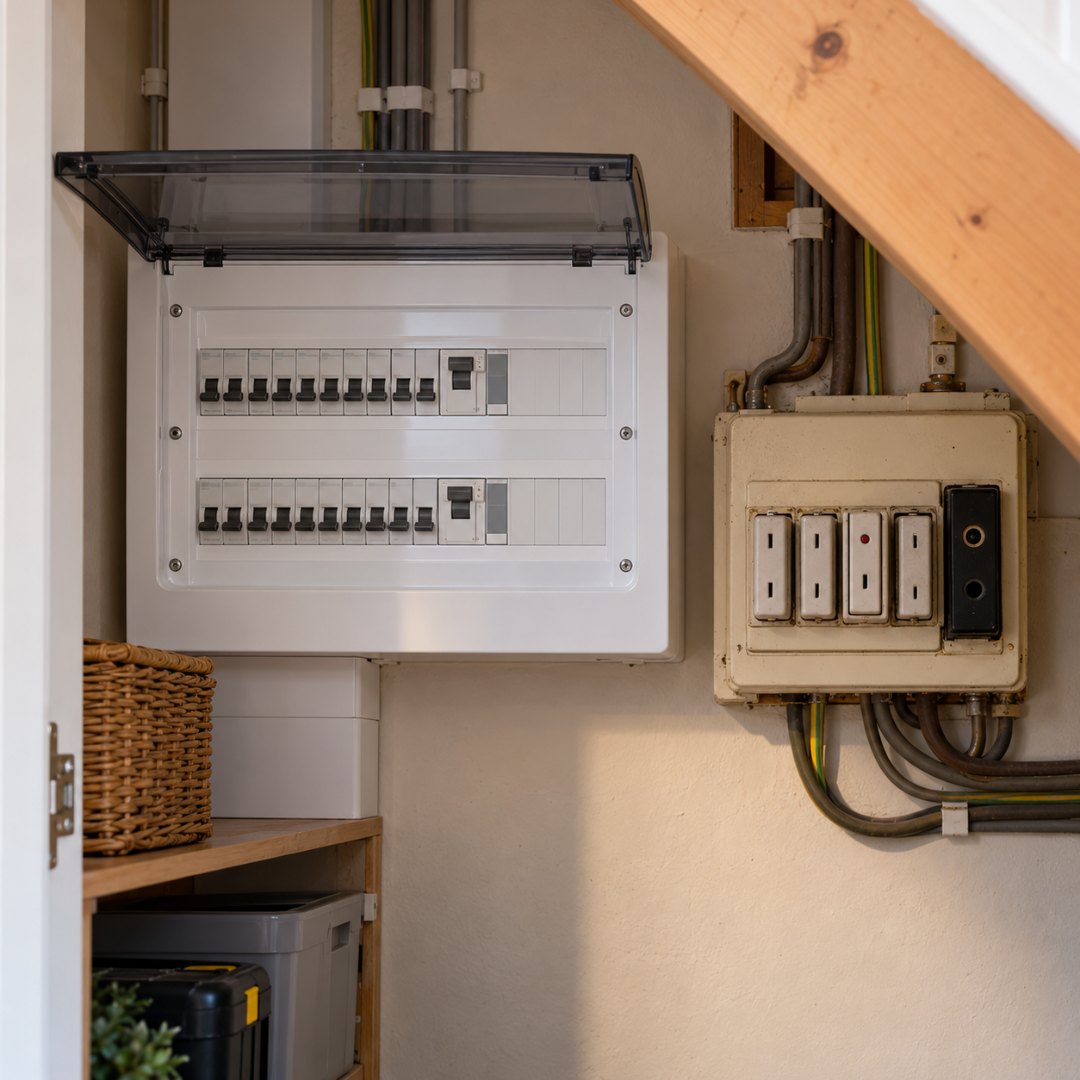
What a fuse board does
NICEIC calls the consumer unit the central control hub for your home's electrics. Power comes in from the meter and the board shares it out into separate circuits for sockets, lights, the cooker and so on, each with its own protection.
Old fuse box
- Fuses that have to be rewired or replaced after they blow
- Often no RCD protection at all
- Usually no spare space for new circuits
Modern consumer unit
- Circuit breakers you reset with a switch
- RCD protection on most, if not all, circuits
- A fire-resistant enclosure, usually steel, on boards fitted since 2016
- Room for surge protection and new circuits
NICEIC recommends replacing an old fuse box with a modern consumer unit.
Signs your fuse board needs replacing
- It has old fuses with fuse wire, or cartridges you replace when they blow, instead of switches you reset.
- There is no RCD, or you cannot see one rated at 30 mA.
- Pressing the RCD's test button does not turn the power off.
- You can see burn marks on the board or on sockets, or smell burning, which some people describe as a fishy smell.
- It keeps tripping. That can point to a faulty appliance, fitting, wiring or the RCD itself.
- There are gaps in the front of the board where the blanking pieces are missing, leaving live parts reachable.
- It has no room for the circuits you want next, such as an electric car charger, a heat pump, solar panels, a battery or an extension.
- An electrical inspection report (EICR) recommends replacing it.
Why RCDs matter so much
An RCD switches the power off the moment electricity starts flowing where it should not, such as through a person.
RCDs are far more sensitive than ordinary fuses and circuit breakers, which are there to protect the wiring rather than people. An RCD fitted in the fuse board protects everything on its circuits, and the wiring rules have called for RCD protection on virtually every circuit in new and rewired homes since 2008. Press the test button now and then: it should cut the power straight away.
What current wiring rules expect
These rules apply to new work. An older board that met the rules of its day is not automatically unsafe, but it will not have the protection a new one gives.
- The wiring rules
- BS 7671, the IET Wiring Regulations, 18th Edition. Amendment 4 was published on 15 April 2026 and became the only version in use from 15 October 2026
- The enclosure
- Since 1 January 2016, a new consumer unit in a home must have a fire-resistant enclosure, which in practice means steel
- RCDs
- 30 mA RCD protection is required for socket outlets up to 32 A, and on most other circuits in a home
- Surge protection
- Protection against power surges, such as from lightning, is required unless the owner chooses to accept the risk
- Arc fault detection
- Required on socket circuits in shared houses, student accommodation, care homes and high-rise flats. Recommended in other homes
- Building regulations
- Replacing a consumer unit is notifiable work under Part P in England and Wales, so it must be done by a registered electrician or approved by building control
Do I need to replace a plastic consumer unit?
Not just for being plastic
The steel rule applies to boards fitted from 2016, and it does not mean an older plastic board has to come out. On an inspection report, a plastic board is only flagged if it sits under a wooden staircase or on the only way out of the house.
The choices when you replace it
Two RCDs share the circuits
Circuits are split between two RCDs, so a fault on one side does not cut power to the whole house, but it can turn off every circuit on that side.
Protection for each circuit
An RCBO combines an RCD and a circuit breaker for a single circuit, so a fault only turns off the circuit it is on.
Surge and arc fault protection
A surge protector guards against power spikes such as lightning. An arc fault device cuts the power when it detects the kind of electrical arcing that can start a fire.
What replacing it involves
- We look at the existing board, the earthing and the circuits, and agree the new board and any extras with you.
- The power is off while the board is changed, so plan around freezers, home working and anything that needs to stay on.
- Every circuit is tested, and each switch is clearly labelled so you know what it controls.
- The work is notified under Part P, and you get the certificate for the work and the building regulations paperwork.
How PulseNord replaces a fuse board
PulseNord is the electrical contractor in Nord Group. We tell you plainly whether your board needs replacing or not, and if it does, you get the price in writing before anything is booked.
Worried about your fuse board, or need room for a car charger, heat pump or solar panels? Request a quote from PulseNord and you will get the price in writing before anything is booked.
Get a QuoteQuestions people ask
Is it illegal to have an old fuse box?
No. The wiring rules apply to new work, so an old board is not illegal. It may not protect you the way a modern board with RCDs does, so it is worth having it checked.
Do I need a metal consumer unit?
A new consumer unit fitted in a home since 1 January 2016 must have a fire-resistant enclosure, which in practice means steel. An existing plastic board does not have to be replaced for that reason alone.
Why does my RCD keep tripping?
Frequent tripping can be caused by a faulty appliance, a faulty fitting, the wiring or the RCD itself. If it keeps happening, stop using that circuit and get a registered electrician to find the cause.
Do I need a new fuse board for an electric car charger or heat pump?
Often, if the board has no spare space or no suitable protection for the new circuit. We check this when we quote for the new circuit.
Can any electrician replace a consumer unit?
In England and Wales it is notifiable work under Part P. It has to be done by an electrician registered with a competent person scheme, or inspected and approved by building control.
Where these facts come from
- What a consumer unit is, fuse box versus consumer unit, signs it needs replacing (regulations, no RCDs or SPDs, more capacity), RCDs, dual R…checked 2026-10-24
- Electrical Safety Roundtable visual guidance: burning smell described as fishy, burn marks on accessories, missing blanks, unclear circuit l…checked 2026-10-24
- What RCDs do, more sensitive than fuses and circuit breakers, fixed RCDs in the consumer unit, BS 7671:2008 calls for RCD protection on virt…checked 2026-10-24
- Regulation 421.1.201: non-combustible consumer unit enclosures in domestic premises from 1 January 2016, existing plastic units only noted i…checked 2026-10-24
- Amendment 4 to BS 7671:2018 published 15 April 2026, previous version withdrawn 15 October 2026checked 2026-10-24
- Amendment 4 to be implemented immediately on publication on 15 April 2026, previous version withdrawn six months afterchecked 2026-10-24
- Amendment 2: AFDDs required in higher risk residential buildings, HMOs, purpose built student accommodation and care homes and recommended e…checked 2026-10-24
- Amendment 2 AFDD and SPD requirements cross-checkchecked 2026-10-24
- Notifiable electrical work in England: new consumer unit, new circuits; registered competent person or building controlchecked 2026-10-24